
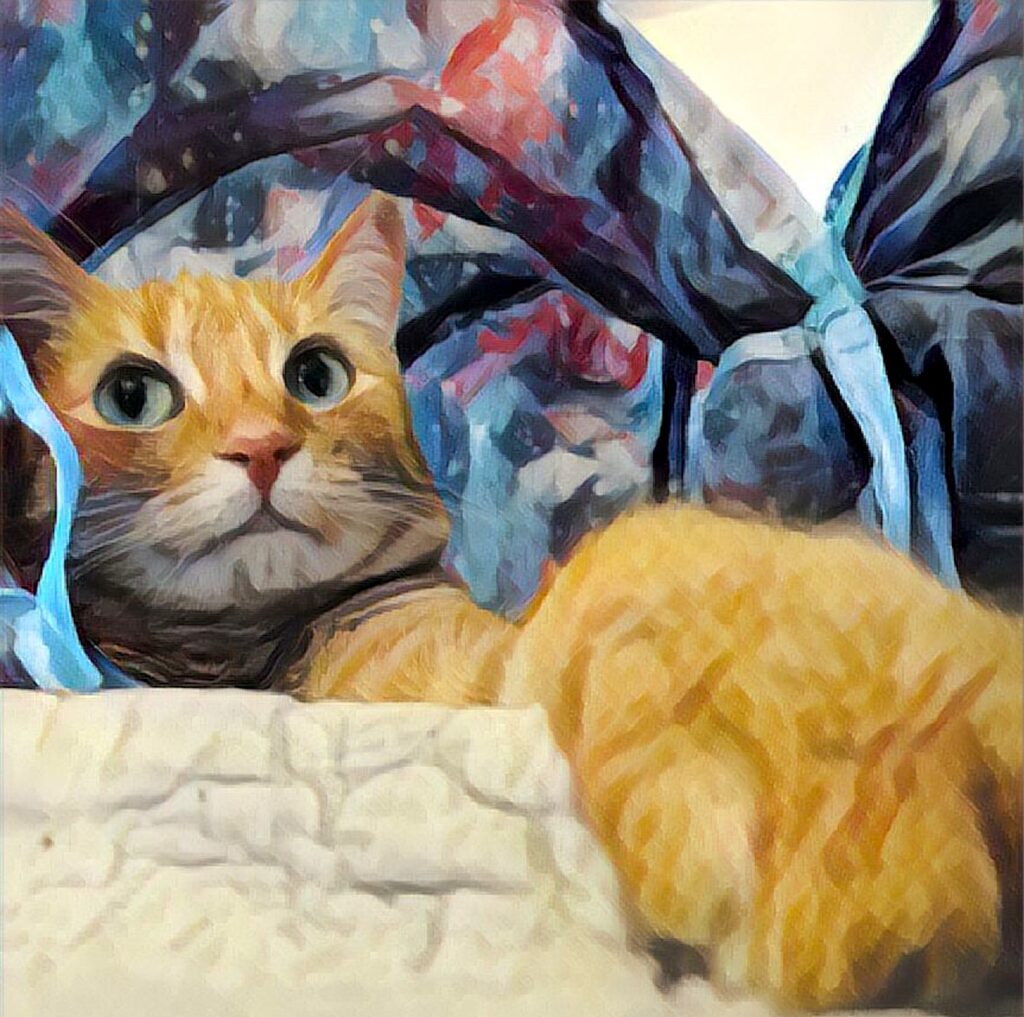
Are cats good for children? Are children good for cats?
Ginger Grrrl weighs in.
Dear Human:
I guess it’s no surprise that children are attracted to me like bees are to honey.
But, it turns out that, as a cat, I’m not that special in this respect. Most kids LOVE us cats.
I did some research, dear human, and guess what? Some children feel closer to their pets than to their siblings or other people in their lives [1]. Some even say they prefer talking to their pets rather than to adults or other children. Can you blame them?
Let’s face it. Not only are we cats soft and adorable, we’re also great listeners. We don’t interrupt, judge, or tell kids to clean their rooms.
So, busy parents, once again we cats are here to save the day.
Four Ways That Cats Can Be Good for Kids
1. Cats Can Provide Comfort and Companionship.
Sometimes, children need someone who will simply sit beside them and listen.
Not every child receives the love and healthy attention they need from the adults in their lives. Unfortunately, for some children, a cat is the family member that makes them feel safest, most listened to, and most cared for. Gentle human, you know that childhood isn’t all fun and games.

Consider kids who are ill and have to go to the hospital. Having an animal present during a medical exam helps many young children feel less anxious and stressed [2].
For children in the hospital, physical contact with an animal is associated with being less sad and stressed. For example, among kids dealing with cancer, having an animal present during treatment was associated with lower pain, confusion, irritation, anxiety, and stress [3]. Pretty cool, right?
For more on animal-assisted therapy, see What is Animal-Assisted Therapy?
3. Cats May Help with Social Skills and Self-Esteem

Across the globe, research suggests that kids who have pet companions have higher self-esteem, more friends, better social skills, and play more than kids without animals [4].
How might this work? Caring for a cat gives children opportunities to practice important social skills like patience, noticing another living creature’s needs, and building a relationship based on trust.
Of course, having a cat doesn’t guarantee these benefits. A child’s experience depends on many things, including how the adults in their lives guide them to behave around cats.
Cats have been good friends for kids with Autism, too. One study of children with Autism compared half whose families adopted a shelter cat with those who had not (the “control group”). Kids who got a cat showed more social skills and less anxiety. Children and parents also felt strong emotional bonds with their new cat. Importantly, when families who didn’t get a cat (the control group) finally received one, the kids and families showed the same positive changes, and these improvements lasted over time.
For more on animal-assisted therapy, see What is Animal-Assisted Therapy?
2. Cats Can Help Kids Feel Less Stressed.
4. Cats Can Become Beloved Family Companions
For many children, we cats become much more than a “pet.” A feline friend may be a beloved member of the family for years.
And let’s not forget the fun! Playing with a cat using a wand toy, watching a kitten explore, or simply enjoying a purring companion can create happy memories for the whole family.
Now, a Plea on Behalf of Cats Everywhere
Gentle Human,
Now that you know how great cats are for kids, I have a request.
Before you bring a cat into my home, make sure that your child is ready to respect my body and my feelings.
I have to be straight with you, human. Some of your children, especially those under six years, scare the bejesus out of me. Many of these children have zero self-control. Please, do NOT leave me alone with one of these monsters!
Young children need close adult supervision, and older children need guidance, too [6].
If frightened, even a gentle cat may scratch or bite. And even a well-meaning child can accidentally injure a cat. Here are my suggestions for keeping cats and children safe.
Thinking of bringing a cat home with you? Read more about How to Teach Kids to Interact with Pets.
Please Train Your Monster Children
Most times a child harms an animal, it’s because they are not properly supervised or have not been taught how to handle them safely.
Many kids, especially those under six, don’t understand that animals can feel pain [5].
I beg of you, please supervise young children when they are with a pet.
Over time, a four- or five-year-old may prove that they can be trusted with an animal. In my experience, human children over six are a bit more civil. Still, some older children need to be taught how to treat cats. Luckily, most kids this age can listen and learn rules about when and how to come near us without harming us.
Children learn by watching adults, so please set a good example. Speak calmly and show them how to pet a cat gently [6]. Start by making sure your children ask our permission before they touch us with their grubby paws—and to respect our answer when we walk away!
If a cat becomes a part of your family, make sure her favorite bed is a safe space in a quiet part of your home [5], well out of little Chucky’s reach.
What to Do If Your Child Is Deliberately Cruel to an Animal
Oh naïve human parent, please be aware that animal abuse should always be taken seriously.
If your child deliberately hurts an animal, repeatedly ignores instructions to stop, or seems to enjoy causing suffering, protect the cat immediately and speak with a qualified mental health professional or pediatrician. Don’t dismiss deliberate cruelty as a phase or assume your child will grow out of it. The important thing is to protect the animal and take repeated or deliberate harm seriously [7]. Deliberate animal cruelty is your child’s way of waving a red flag and saying, pick up the phone now and get me professional help!
And please remember that not every child who hurts an animal is cruel. Young children need patient teaching, close supervision, and clear, consistent boundaries.
Are Cats Good for Children? The Bottom Line.
Most kids love cats. And with some early guidance from an adult, a cat can become a cherished companion who brings comfort, fun, and happy memories to a human child’s life.
In my feline opinion, many kids, especially those who prove themselves to be kind to animals, could use a cat around to support them.
Children deserve to learn about our greatness, whether it’s through a visit to a cat cafe or shelter, or by adopting their own cat companion. But it’s up to you adults to teach children how to treat us with kindness and respect. Do that, and we will have years of happiness together.
More Guidance on Cats and Children
Now, like humans, cats vary in their tolerance for chaos and manhandling. Therefore, some are better around kids than others. For help choosing the right kind of cat for your child’s age, your lifestyle, and your home environment, check out: https://www.cats.org.uk/help-and-advice/cats-and-your-family


Do you think cats are good for children? Please share a comment below.
REFERENCES
Cassels, M et al. (Jan 2017). One of the family? Measuring early adolescents’ relationships with pets and siblings. Journal of Applied Developmental Psychology. DOI: 10.1016/j.appdev.2017.01.003
Hansen, K. M., Messinger, C. J., Baun, M. M., & Megel, M. (1999). Companion animals alleviating distress in children. Anthrozoös, 12(3), 142-148. https://www.tandfonline.com/doi/abs/10.2752/089279399787000264
Silva, N. B., & Osório, F. L. (2018). Impact of an animal-assisted therapy programme on physiological and psychosocial variables of paediatric oncology patients. PloS one, 13(4). https://pubmed.ncbi.nlm.nih.gov/29617398/
Purewal, R., Christley, R., Kordas, K., Joinson, C., Meints, K., Gee, N., & Westgarth, C. (2017). Companion animals and child/adolescent development: a systematic review of the evidence. International journal of environmental research and public health, 14(3), 234. https://pubmed.ncbi.nlm.nih.gov/28264460/
Cats Protection. Cats and children, Downloaded on February 24, 2024 from https://www.cats.org.uk/help-and-advice/cats-and-your-family/cats-and-children.
- Johnston, Joni (2011). Children Who Are Cruel to Animals: When to Worry. Psychology Today. https://www.psychologytoday.com/us/blog/the-human-equation/201104/children-who-are-cruel-animals-when-worry.
Wauthier, L., & Williams, J. M. (2022). A qualitative study of children’s accounts of cruelty to animals: Uncovering the roles of trauma, exposure to violence, and attachment. Journal of Interpersonal Violence, 37(9–10), NP6405–NP6438. https://doi.org/10.1177/0886260520928640 [1]
During the past year my daughter and her little son have visited me on numerous occasions. It’s a joy to see the attention both my cat, Hanni, by name, and Deveraux, my grandson, give one another.
There has only been one occasion when separation was necessary, owing to the combined interest in some food we were making for lunch…. ! Both seemed determined to try the dishes, ( might have been because some contained a few fragrant spices and garlic )
Hanni was given suitable arrangements in an adjoining room, with closed window between. However, the pair of them only appeared to care about being next to one another again…. Peeping through the window towards one another.
Perhaps it’s advantageous to introduce young children to cats as early in life as possible. Slowly but surely, of course.
So far, there’s not been any sign of any aggravation or cruel treatment from either. Cats are a blessing, just take care when introducing them to little ones.
Wonderful post, Mewla. I raised my two kids alongside three cats. I don’t know what we would have done without our feline campanions. I absolutely believe that my kids learned a great deal of compassion by caring for our cats. My daughter and I spent years volunteering together at our local SPCA in the feline department, where we all benefitted.
Thanks for this interesting article. I wonder how many adults prefer animals over people? I taught my kids to be kind to animals, but as toddlers, they were like wrecking balls.
Great article. My cat helped me through hard times when I was growing up. If I have kids, they will have cats!